The 1918 Influenza Pandemic: The Forgotten Fury
In the annals of human suffering, one calamity stands eerily overshadowed by the very war it accompanied. The 1918 Influenza Pandemic—misnamed the "Spanish Flu"—did not merely circle the globe; it seized it by the throat. Between the spring of 1918 and the summer of 1919, it infected an estimated one-third of the world's population and killed approximately 50 million people, though some scholars place the true toll as high as 100 million. To put this in perspective: the Great War, which had consumed nations for four years, claimed roughly 20 million lives. The flu killed more in 24 weeks than AIDS has in 24 years.
Yet, remarkably, this apocalypse has faded from public memory. Recovering its story is not merely an act of historical duty—it is a urgent lesson for a world that will inevitably face another pandemic. This premium article explores the virology, the social catastrophe, the baffling epidemiology, and the enduring legacy of history's deadliest outbreak.
I. The Virus: An Unseen Enemy
The culprit was an H1N1 influenza A virus of avian origin. Unlike seasonal flu, which kills primarily the very young and the elderly, the 1918 strain possessed a terrifying, and still-not-fully-understood, virulence. Genomic reconstructions from preserved lung tissue of victims (including bodies exhumed from permafrost in Alaska) have revealed a virus that triggered a "cytokine storm"—a devastating overreaction of the immune system, where the body essentially drowns in its own defenses.
Recent research has identified key genetic mutations that allowed the virus to replicate efficiently in human lung tissue, causing severe viral pneumonia and acute respiratory distress syndrome (ARDS). Victims often turned a dark, cyanotic blue from lack of oxygen—a condition so distinctive that doctors called it "heliotrope cyanosis." Some died within 48 hours of their first symptom.
Why "Spanish Flu"? A Misleading Name
The pandemic did not originate in Spain. Wartime censorship in France, Germany, the United States, and Britain suppressed news of the outbreak to protect morale. Spain, as a neutral nation, allowed its press to report freely on the epidemic—including the fact that King Alfonso XIII fell gravely ill. Thus, the world falsely labeled it "Spanish Flu," a geopolitical artifact that persists to this day. The true geographic origin remains debated, with leading theories pointing to military camps in Kansas, trenches in France, or even unsuspecting villages in China.
II. The Three Waves: A Chilling Rhythm
The pandemic arrived not as a single blow, but in three distinct waves, each with its own character.
- Spring 1918 (The Mild Herald): A relatively mild wave appeared in the United States and Europe. Symptoms resembled common flu. Most patients recovered, and health officials paid little attention. This wave built population-wide immunity? No—instead, it lulled the world into a fatal complacency.
- Autumn 1918 (The Killer Wave): The virus returned in September with a vengeance, having mutated into a far deadlier form. Philadelphia held a liberty loan parade on September 28 despite warnings; within 72 hours, every hospital bed was full. Within a week, 4,500 were dead. Morgues overflowed. Corpses waited days for burial.
- Winter–Spring 1919 (The Lingering Ghost): A third wave, less lethal but still devastating, swept through Australia, Japan, and isolated populations. It finally burned out by mid-1920, having killed more people than the entire First World War.
Key statistic: In the United States alone, the 1918 flu killed 675,000 people—more than all American combat deaths in the 20th century combined (World War I, World War II, Korea, Vietnam, and the Gulf Wars).
III. The W-Shaped Curve: A Medical Mystery
Seasonal influenza typically produces a U-shaped mortality curve: infants and the elderly die most. The 1918 pandemic produced a W-shaped curve—with a terrifying, unprecedented peak among young adults aged 20 to 40. This was "the prime of life" being wiped out.
Why? The leading hypothesis is that older adults (born before 1889) carried immunity from a previous, related H1N1 virus that had circulated decades earlier. Young children had immature immune systems but often milder responses. However, healthy young adults mounted the strongest immune responses—and in this case, that strong immune response proved deadly, as the cytokine storm ravaged their own lungs. Pregnant women faced an especially grim prognosis: mortality rates reached 26% in some studies, and those who survived often lost their unborn children.
- Sudden onset: Many victims remembered feeling perfectly healthy in the morning and being incapacitated by noon.
- Extreme symptoms: Hemorrhaging from the nose, ears, and eyes; blood-filled blisters on the skin; delirium and hallucinations.
- Rapid progression: From first cough to death in as little as 12 hours in the most aggressive cases.
IV. The World in Crisis: Public Health Then and Now
Without vaccines, antivirals, or intensive care units, cities fell back on a century-old arsenal: non-pharmaceutical interventions. These measures would feel familiar to any reader who lived through the COVID-19 pandemic, yet their application was far more inconsistent and desperate.
- Quarantines and isolation: Entire towns, from Gunnison, Colorado (which sealed itself off completely and survived with zero cases) to remote Pacific islands, barricaded roads and shot anyone attempting entry.
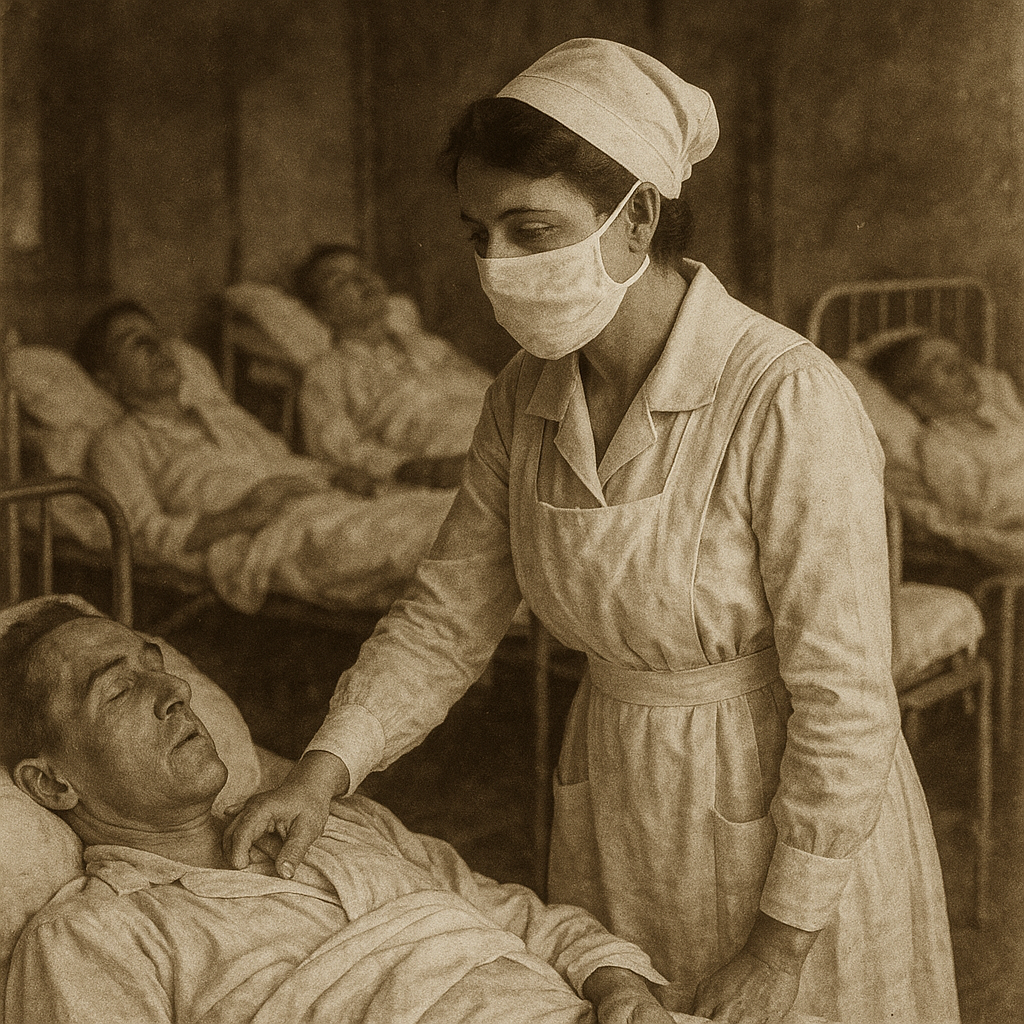
- Face masks: San Francisco became a "mask city" with fines for violators. Some masks were four layers of gauze; others were made of cellophane or even cheesecloth. Effectiveness varied wildly.
- Closure of public spaces: Churches, schools, theaters, and saloons were shuttered. In some cities, anti-spitting ordinances were strictly enforced.
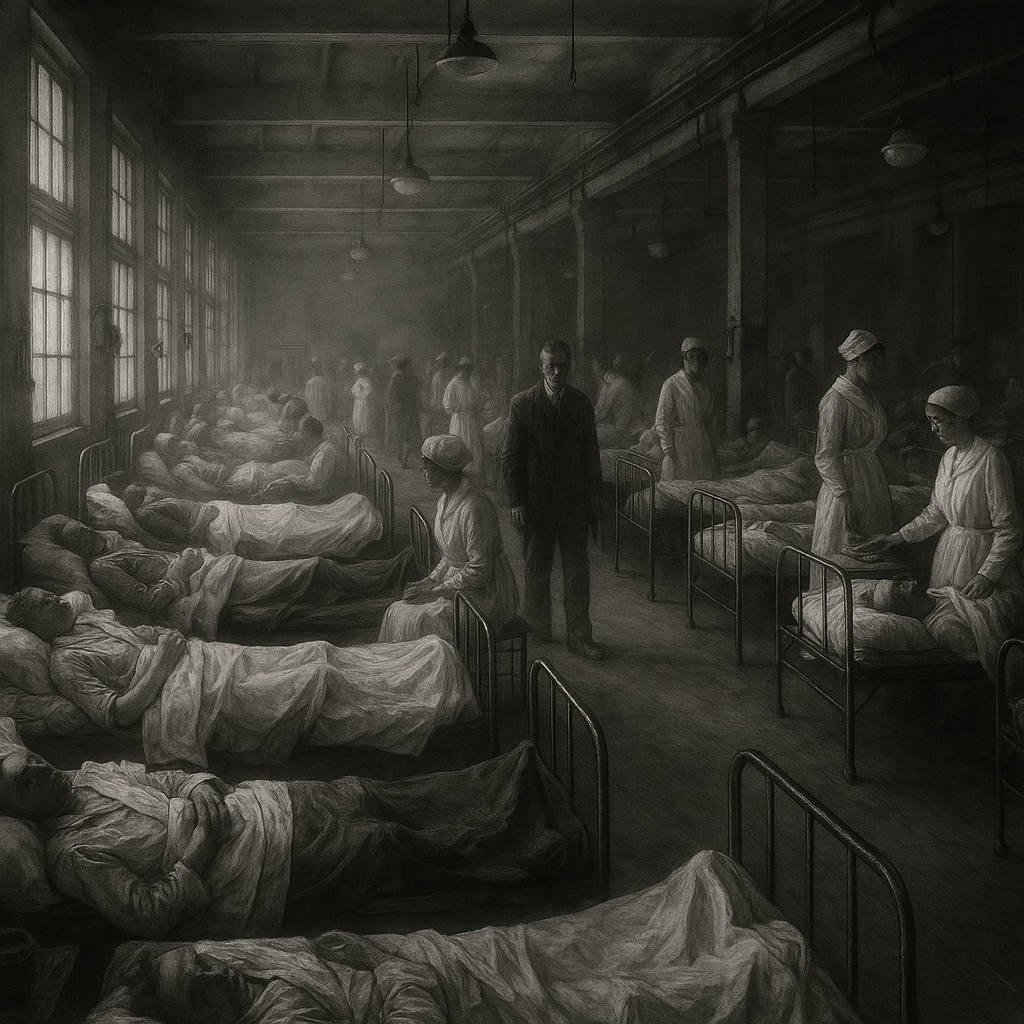
- Hospitals overflowed: Makeshift wards were set up in armories, college gymnasiums, and even tents in public parks. Nurses were in such short supply that medical students and nuns volunteered.
Yet responses were radically uneven. Some cities (St. Louis, with swift and sustained closures) saw mortality rates half of those in cities that delayed (Philadelphia, which held its deadly parade). The lesson, later codified in pandemic science, was clear: early, layered, and sustained interventions save lives. Delaying by even one week can multiply deaths several times over.
V. The Aftermath: Grief, Silence, and Science
When the virus finally receded, the world did not celebrate. It was exhausted, traumatized, and eager to forget. The war had ended in November 1918, and the postwar "Roaring Twenties" seemed to deliberately erase the flu from collective memory. No grand monuments were built. Few memoirs mentioned it. This "collective amnesia" would prove costly, as the same mistakes—delayed responses, mask resistance, misinformation—would reappear a century later.
But behind the silence, transformative changes took root:
- Public health infrastructure: The pandemic catalyzed the creation of national health ministries and disease surveillance systems. The League of Nations (predecessor to the WHO) established an epidemiology intelligence service.
- Vaccine research: Although no effective flu vaccine existed in 1918, the desperate search for one laid groundwork for the eventual development of influenza vaccines in the 1930s and 1940s.
- Scientific cooperation: The pandemic accelerated international sharing of pathological data and serum samples, a precursor to modern global health networks.
- Understanding of viral evolution: The 1918 virus became the "mother" of all subsequent H1N1 strains, including the 2009 swine flu pandemic. Studying its genome has revolutionized pandemic preparedness.
VI. Lessons for a Fragile World
The 1918 Influenza Pandemic is not a relic—it is a warning etched in tissue samples and mass graves. Its voice speaks directly to the present. When COVID-19 arrived in 2020, the parallels were immediate and haunting: the same debates over masks, the same strain on hospitals, the same bewildering spread. Some nations remembered the 1918 playbook and acted early; others repeated the delays of Philadelphia.
Three enduring lessons stand above all others:
- Speed is everything. In pandemics, the first weeks are the difference between containment and catastrophe.
- Transparency is not weakness. Wartime censorship worsened the 1918 pandemic; open communication saves lives.
- Global health is collective security. A virus anywhere is a virus everywhere. International cooperation, not blame, is the only rational response.
The 1918 pandemic was the dress rehearsal for a century of emerging infections—HIV, SARS, H1N1, Ebola, COVID-19, and the inevitable "Disease X" yet to come. To forget 1918 is to forfeit its hard-won wisdom. To remember it is to arm ourselves with the most powerful weapon of all: knowledge.
In memoriam: The 50 million who died had no vaccine, no ventilator, no warning. Their ghost teaches us that nature is not sentimental, that health is a matter of days, and that human solidarity—when we choose it—remains our only defense against the microscopic predator.
— This premium article is part of a public health historical series. References include primary sources from the U.S. National Archives, the CDC's 1918 Pandemic Commemoration, and peer-reviewed virology from the Journal of Infectious Diseases.