The Holocaust: The Industrialized Murder of Six Million Jews
In the annals of human cruelty, no event stands as a more profound indictment of civilization than the Holocaust. From 1941 to 1945, Nazi Germany and its collaborators systematically murdered approximately six million Jews—roughly two-thirds of Europe's Jewish population. This was not a byproduct of war nor a series of pogroms. It was a deliberate, state-sponsored, continent-wide extermination project driven by ideology, bureaucracy, and modern industrial methods. The Nazis called it the "Final Solution to the Jewish Question." The world calls it the Shoah—catastrophe.
This premium article traces the arc from ancient hatred to systematic annihilation, examining the machinery of death, the victims' unimaginable suffering, and the haunting legacy that demands: never again, and yet again.
I. Antisemitism: The Oldest Hatred Weaponized
Judeophobia did not begin with Hitler. For nearly two millennia, European Christianity had blamed Jews for the death of Jesus, restricted their professions, confined them to ghettos, and periodically massacred them during Crusades, plagues, and blood libels. But the Nazi variant grafted modern pseudoscience onto ancient prejudice.
- Racial antisemitism: Unlike religious anti-Judaism, Nazi ideology held that Jewishness was biological and unchangeable—a "race" determined by blood, not faith. Conversion offered no escape.
- The Protocols of the Elders of Zion: This notorious forgery, purporting to reveal a Jewish conspiracy for world domination, was widely circulated after World War I and became a foundational Nazi text.
- The Stab-in-the-Back Myth: Many Germans refused to accept military defeat in 1918. Instead, they blamed Jews and socialists for "betraying" the German army, a lie that festered throughout the Weimar Republic.
Adolf Hitler, a failed artist and decorated World War I veteran, channeled these resentments into Mein Kampf (My Struggle), where he wrote: "If at the beginning of the War and during the War twelve or fifteen thousand of these Hebrew corrupters of the people had been held under poison gas, then the sacrifice of millions at the front would not have been in vain." This fantasy would become blueprint.
II. From Persecution to Annihilation: The Radicalization Path
The Holocaust did not spring fully formed in 1941. It evolved through escalating stages, each radicalized by war, opportunity, and the absence of international intervention.
1933–1939: Legalized Exclusion and Violence
- April 1933: Nazi-led boycott of Jewish businesses. The Law for the Restoration of the Professional Civil Service dismissed Jews from government employment.
- September 1935: Nuremberg Laws stripped Jews of German citizenship, forbade marriage or sexual relations between Jews and Germans, and defined Jewishness by grandparents' religious identity.
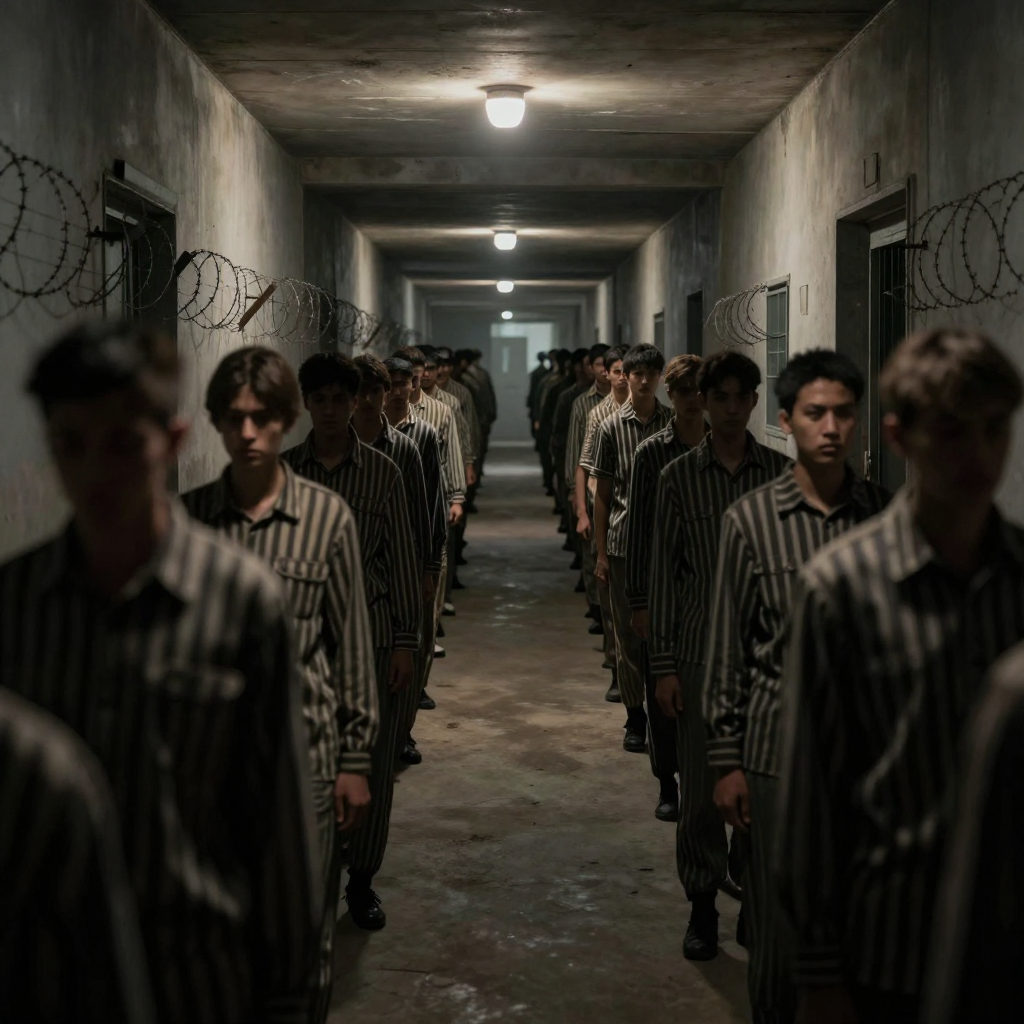
- November 9–10, 1938: Kristallnacht ("Night of Broken Glass")—a state-organized pogrom that destroyed over 7,000 Jewish businesses, 1,400 synagogues, and killed at least 91 Jews. Thirty thousand Jewish men were arrested and sent to Dachau, Buchenwald, and Sachsenhausen concentration camps.
By 1939, roughly half of Germany's 500,000 Jews had fled. Those who remained found themselves trapped, impoverished, and marked.
1939–1941: Ghettoization and Mass Shootings
- Invasion of Poland (September 1939): With over three million Jews now under Nazi control, the regime established sealed ghettos—urban prisons of starvation and disease. The Warsaw Ghetto held up to 450,000 people in 1.3 square miles. Monthly mortality rates reached 5,000 from hunger and typhus.
- Operation Barbarossa (June 1941): The invasion of the Soviet Union unleashed Einsatzgruppen (mobile killing units). Following the regular army, these SS death squads rounded up Jews, communists, and Roma, marched them to ravines or forests, and shot them. At Babi Yar outside Kyiv, 33,771 Jews were murdered in two days. Across the Soviet Union, Einsatzgruppen killed over 1.5 million Jews by bullets and bayonets.
But shooting proved "inefficient." The killers suffered psychological trauma. The regime sought a more "humane" (for the killers) and "industrial" method.
III. The Final Solution: Factories of Death
On January 20, 1942, fifteen senior Nazi officials met at a lakeside villa in Wannsee, Berlin. Chaired by Reinhard Heydrich, the Wannsee Conference coordinated the "Final Solution of the Jewish Question"—the systematic deportation and extermination of all eleven million European Jews, from Ireland to the Urals.
The chosen method: extermination camps equipped with stationary gas chambers and crematoria.
The Killing Centers
- Operation Reinhard camps (1942–1943): Belzec, Sobibor, and Treblinka were built specifically for mass murder. Victims arrived by train, were stripped, marched into gas chambers disguised as showers, and killed by carbon monoxide exhaust from captured Soviet tank engines. At Treblinka, an estimated 800,000–900,000 Jews were killed in just 15 months. Only 67 survivors are known.
- Auschwitz-Birkenau: The largest and most infamous camp, Auschwitz evolved into a dual-purpose labor and extermination complex. Birkenau (Auschwitz II) contained four large gas chambers with Zyklon B (hydrogen cyanide) and five crematoria. Between 1.1 and 1.3 million people died at Auschwitz, of whom roughly 1.1 million were Jews. Victims included 232,000 children under 15.
- Chelmno (Kulmhof): The first stationary killing center, using gas vans—sealed trucks whose exhaust was piped into cargo compartments. 150,000 Jews, mostly from the Łódź ghetto, were suffocated there.
- Majdanek: A combined camp and extermination facility with gas chambers and crematoria. At least 78,000 Jews perished there.
The arithmetic of hell: At the height of deportations from Hungary in spring 1944, up to 12,000 Jews were gassed daily at Auschwitz-Birkenau. The crematoria sometimes malfunctioned from overuse; bodies were burned in open pits. The Nazis recorded everything: train schedules, property inventories, gold teeth extracted from corpses.
IV. Who Else Was Murdered?
While Jews were the primary target—marked for total annihilation—the Nazi genocide machine slaughtered millions of other "enemies of the German people."
- Roma and Sinti (Porajmos): Approximately 220,000–500,000 Roma were killed, representing up to 25% of Europe's Roma population.
- Slavic civilians and POWs: At least 3.3 million Soviet prisoners of war died of starvation, exposure, or execution. Millions of Polish and Soviet civilians were murdered in pacification campaigns and forced labor.
- People with disabilities (Aktion T4): Over 200,000 mentally and physically disabled Germans were gassed or injected to death between 1939 and 1941—the program that provided personnel and techniques for the later extermination camps.
- Political opponents: Socialists, communists, trade unionists, and dissidents by the tens of thousands.
- Jehovah's Witnesses: Approximately 1,000–2,500 killed for refusing military service and Nazi allegiance.
- Homosexual men: An estimated 5,000–15,000 sent to camps, where most died under brutal treatment.
Total Holocaust victim count (including all groups) exceeds 11 million non-combatants murdered in camps, ghettos, and mass shooting sites.
V. Resistance, Rescue, and Indifference
Jewish resistance took many forms—spiritual, cultural, and armed. The Warsaw Ghetto Uprising (April–May 1943) saw poorly armed Jewish fighters hold off German forces for nearly a month before the ghetto was burned to the ground. Similar uprisings occurred in Treblinka (August 1943), Sobibor (October 1943), and Auschwitz (October 1944, when Sonderkommando prisoners blew up Crematorium IV).
Rescuers emerged in rare corners of Europe. Denmark evacuated nearly its entire Jewish population (7,200 out of 7,800) to neutral Sweden in fishing boats. Raoul Wallenberg, a Swedish diplomat in Budapest, issued protective passports and saved tens of thousands of Hungarian Jews. Oskar Schindler and Irena Sendler (who smuggled 2,500 Jewish children out of the Warsaw Ghetto) became symbols of individual courage.
But the broader international response was shameful. The Evian Conference (1938), called by President Roosevelt to address Jewish refugees, saw 32 nations offer excuses. Australia said: "We do not have a racial problem; we do not wish to import one." The United States maintained restrictive quotas. Britain blocked Jewish immigration to Palestine. Ships carrying Jewish refugees, such as the St. Louis, were turned back to Europe—where many passengers later perished.
The Allies knew. Detailed reports from escapees, couriers like Jan Karski, and aerial photographs of Auschwitz reached London and Washington by 1942. Yet bombing the camps or railways was repeatedly refused, citing "military infeasibility." The industrial murder continued until Germany's surrender in May 1945.
VI. Liberation: The Camps Discovered
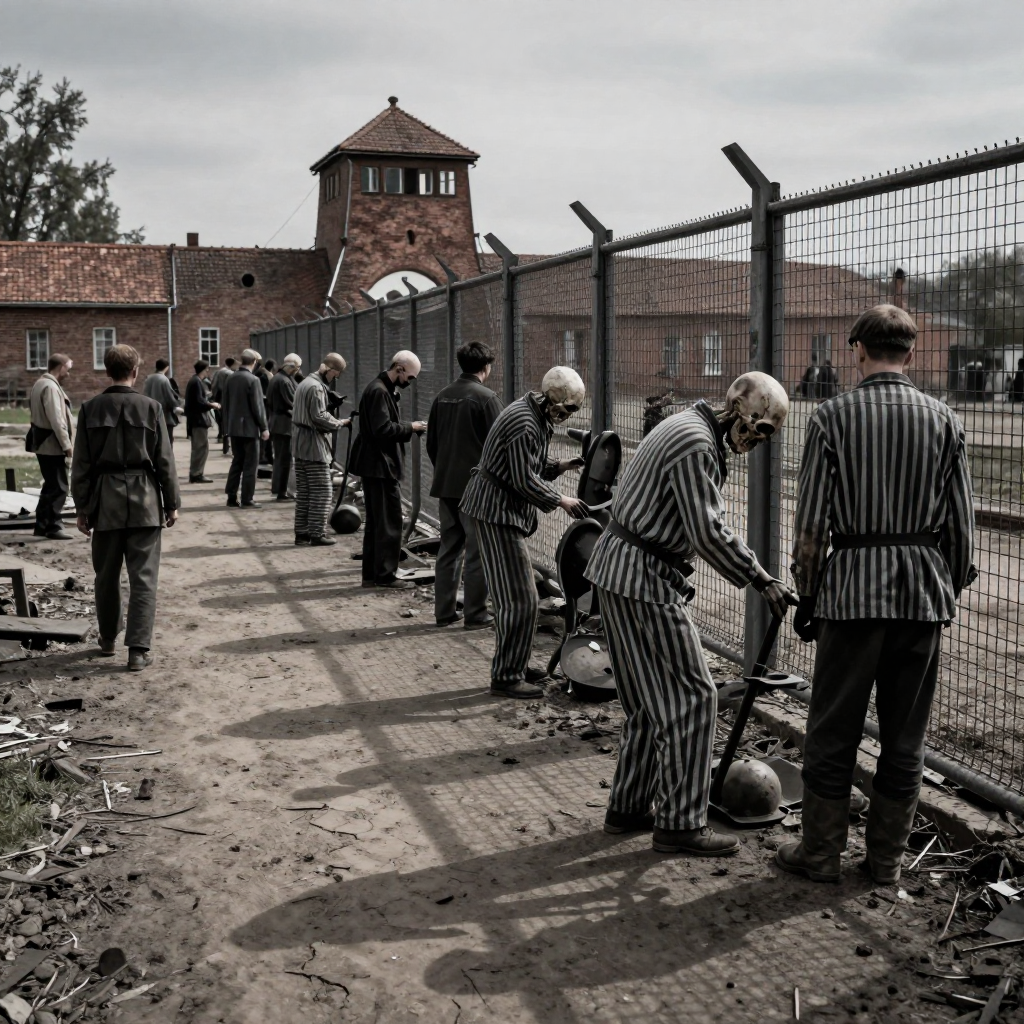
As Allied armies advanced, they encountered horrors beyond imagination. Soviet troops liberated Majdanek (July 1944) and Auschwitz (January 27, 1945), finding gas chambers, crematoria, warehouses filled with hair, clothing, eyeglasses, and 7,000 living skeletons. American forces uncovered Buchenwald and Dachau; the British entered Bergen-Belsen, where Anne Frank and her sister Margot had died of typhus just weeks before.
Survivors—emaciated, traumatized, orphaned—faced a cruel irony: liberation did not bring immediate homecoming. Many remained in displaced persons camps for years, unable or unwilling to return to villages where neighbors had collaborated, where homes and businesses had been stolen.
The world confronted photographic and film evidence—piles of naked corpses, bulldozers pushing bodies into mass graves, the thousand-yard stare of survivors. The phrase "Never Again" was born.
VII. Justice and Denial
In the aftermath, the Allied powers established the Nuremberg Trials (1945–1946), where 22 major Nazi officials were tried for crimes against humanity. Twelve received death sentences. Subsequent trials prosecuted doctors, judges, Einsatzgruppen commanders, and industrialists who used slave labor.
But the vast majority of perpetrators—estimated at over 200,000—never faced any court. Many integrated seamlessly into post-war German society, academia, and government. The "Auschwitz trials" in Frankfurt (1963–1965) came nearly two decades later, and only 17 of 22 accused were convicted.
Meanwhile, Holocaust denial emerged as a poisonous fringe movement, claiming the gas chambers never existed, that six million is a "myth," that the Allies fabricated evidence. Today, denial is illegal in several European nations, yet thrives online. Each survivor who dies—and there are fewer than 200,000 left as of 2025—erodes living testimony, making education ever more urgent.
VIII. Legacy: Why Remember?
The Holocaust is not merely a historical event. It is a rupture in civilization. It forces us to ask: How could a nation of poets and philosophers—Goethe, Kant, Beethoven—organize factories whose sole product was death? How could ordinary men become willing executioners? How could the world watch trains roll toward gas chambers and do nothing?
- Universal human rights: The Nuremberg Trials established that "crimes against humanity" transcend national sovereignty. The 1948 Genocide Convention, drafted in direct response, made genocide an international crime.
- "Never again" as a living promise: From Cambodia (1975–1979) to Rwanda (1994) to Srebrenica (1995) to Darfur (2003–present), the promise has been broken repeatedly. Each failure echoes the Allies' silence.
- The duty of memory: Yad Vashem in Jerusalem, the United States Holocaust Memorial Museum in Washington, D.C., and countless local memorials preserve names, testimonies, and artifacts. Yom HaShoah (Holocaust Remembrance Day) is observed globally.
- Education as prevention: Studies show that Holocaust education reduces antisemitic attitudes—but only when paired with critical thinking and historical depth, not merely abstract horror.
Elie Wiesel, survivor and Nobel laureate, wrote: "For the survivor who chooses to testify, it is clear: his duty is to bear witness for the dead and for the living. He has no right to deprive future generations of a past that belongs to our collective memory."
The numbers are not abstract: Six million. One million children. Each with a name, a laugh, a last letter, a final breath. The Holocaust did not happen to six million. It happened to one person, six million times.
In memoriam: The six million Jewish men, women, and children—and the millions of other victims—who were murdered not for what they did, but for who they were. Zikhronam livrakhah. (May their memory be a blessing.)
— This premium article is part of a series on genocide and human resilience. Sources include the United States Holocaust Memorial Museum, Yad Vashem, the Nuremberg Trials Proceedings, survivor testimonies collected by the USC Shoah Foundation, and the canonical works of Raul Hilberg, Christopher Browning, Saul Friedländer, and Primo Levi.